
Before the Rig Ships: Setting Up a First Mining Account
The fortnight between paying for a miner and plugging it in is the cheapest time to make decisions. A 115 TH/s unit will produce 4.19 USD a day after the listed fee at today's network reading, which is 29.33 USD in its first week. Spend an hour now choosing the payout mode, the address and the alert threshold, and the machine will have somewhere to send its coins on the day it boots.

Key takeaways
- 115 TH/s earns 4.19 USD a day net of the listed 4%, or 29.33 USD in a seven-day week.
- PPS+ is the default and pays hourly against current difficulty; PPLNS pays after six confirmations over the last five difficulty rounds.
- Set the payout address and the low-hashrate alert before the first share, not after the first missed day.
- Judge the first week by coins per day, not by dollars, because the price moves and the hashrate does not.
Pick the settlement mode while the courier still has the box
The choice between PPS+ and PPLNS changes when money arrives and how much it varies, and it is far easier to reason about before the machine is running. PPS+ settles the block-reward component hourly against current difficulty at a listed 4%, and the transaction-fee component at a listed 2%. PPLNS combines both streams, charges a listed 2%, and pays once a block reaches six confirmations, sharing your slice across the last five difficulty rounds.
For a first machine, the hourly rhythm of PPS+ is the simpler thing to learn from. Each hour gives a small, predictable credit that can be checked against a hand calculation, which is how a new miner builds confidence that the account, the worker name and the address are all correct. A PPLNS miner may wait a day or two for the first payment and then see it swing, which is a harder pattern to debug when everything is new.
What 115 TH/s pays at today's numbers
The arithmetic is short and worth doing once by hand so that the dashboard later has something to be checked against. At a network hashrate of 1,003 EH/s and 450 BTC issued a day, one terahash produces 0.00000044865 BTC daily. Multiply by 115 and the daily figure is 0.00005159 BTC.
At 84,692 dollars per coin that is 4.37 USD gross. The listed 4% on the block-reward component takes it to 4.19 USD net, which is the number to compare with the power bill. A modern unit at around 20 J/TH draws about 2.3 kW, or 55 kWh a day, so at six cents a kilowatt-hour the power cost is 3.30 USD and the margin is under a dollar. That thin gap is normal for a single machine and it is why the power price matters more than the pool choice.
Three tiers and their first-week totals
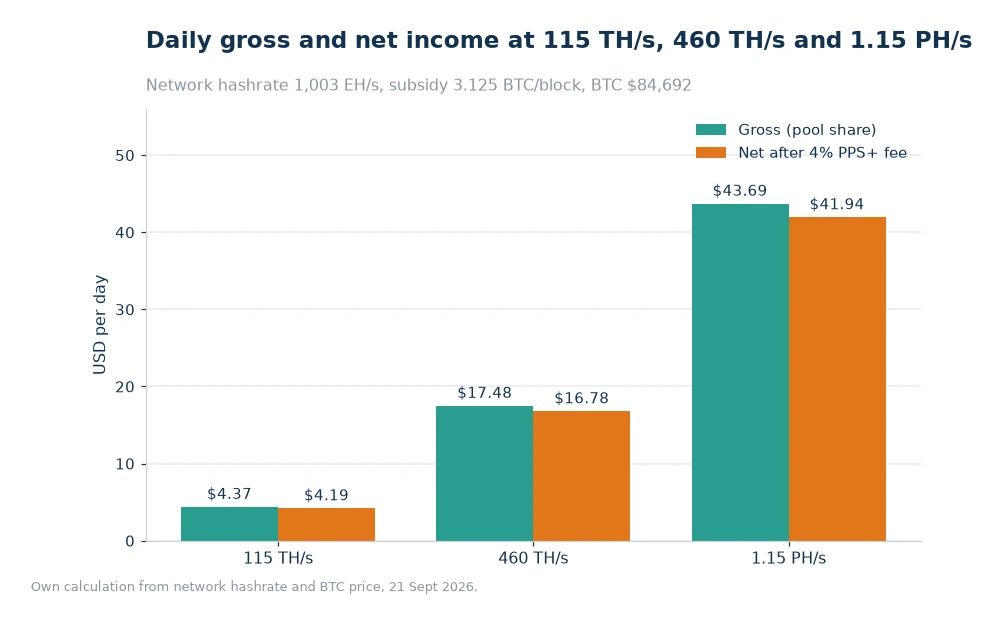
The table widens the view beyond one machine, because a first purchase often becomes a second one within a quarter. Every row uses the same network reading.
| Tier | Gross per day | Net per day | First seven days |
|---|---|---|---|
| 115 TH/s | $4.37 | $4.19 | $29.33 |
| 460 TH/s | $17.48 | $16.78 | $117.46 |
| 1.15 PH/s | $43.69 | $41.94 | $293.58 |
The week column is the one a new miner can actually verify. After seven days the statement should show close to the figure in the last column, minus whatever downtime occurred. If it shows half, the machine ran half the time or the worker name was wrong for part of it. Both are findable in a week; neither is findable in a month.
Worked example
Run the 115 TH/s row from the network inputs to the first-week total.
- A terahash claims 450 ÷ 1,003,000,000 = 0.00000044865 BTC each day.
- At 115 TH/s the machine produces 0.00005159 BTC.
- At 84,692 dollars per coin the gross is 4.37.
- The listed 4% leaves 4.19.
- Seven days: 29.33.
- Power at 20 J/TH: 115 × 20 = 2,300 W, or 2.3 kW; 2.3 × 24 = 55.2 kWh a day.
- At $0.06 per kWh: 55.2 × 0.06 = $3.31 a day, leaving $0.88 of margin before any cooling cost.
The account checklist: address, wallet, alert
Three things need to exist before the first share. The payout address, checked twice against the wallet you actually control. The worker name, so the machine's shares can be told apart from any other unit on the same account. And an alert that fires when hashrate drops, because a machine that quietly loses a board still looks online.
The wallet matters more than it seems. Mining revenue arrives in a coin, and the account that holds it is also the place from which it is later sold, converted or moved. Keeping the mining account and the holding wallet under one login simplifies the record and makes the monthly reconciliation a single screen rather than three exports. ViaBTC's multi-currency wallet sits in the same account as the mining dashboard, which is the practical version of that advice.
For background on the products and the pool itself, ViaBTC Bitcoin Mining is the starting page; it lists the supported coins and the two settlement schemes without requiring an account to read. Bookmark it before the hardware arrives and the setup stops feeling like a scavenger hunt.
Counting the first week honestly
A first week contains two things that will not repeat: a commissioning afternoon and a fresh set of firmware updates. Neither is representative. Count the coins, note the hours the machine actually ran, and divide one by the other to get a per-hour rate. If that rate matches the 0.00000215 BTC an hour implied by 115 TH/s, the setup is correct even if the total looks small.
Do not adjust the plan because of a single day. A day of downtime at the start is a setup cost; a day of downtime in week three is a fault. The difference is whether the cause was found and fixed, and the alert log will tell you which. Keep the log for the first month and it becomes the baseline for every comparison afterwards.
Also write down the ambient temperature of the room during that first week. It explains more variation than most new miners expect, and it gives the second machine a fair comparison when it arrives in a different season. A number recorded now is worth more than a memory of how warm it felt.
Frequently asked questions
How much does a 115 TH/s miner earn in a day?
At the 21 September 2026 network reading it produces 0.00005159 BTC a day, worth 4.37 USD gross and 4.19 USD after the listed 4% on the block-reward component.
Should a first miner choose PPS+ or PPLNS?
PPS+ is the simpler start because it pays hourly against current difficulty, giving a steady credit that is easy to check against a hand calculation; PPLNS pays after six confirmations and varies with pool luck.
What should I set up before the machine arrives?
The payout address, a worker name and a hashrate alert, all under one account, so the first share has somewhere to go and a drop is noticed the same day rather than at month end.
Have the account ready before the box is open
Unboxing goes faster when the destination already exists. Create the account, confirm the address with a small test, set the alert, and write the expected hourly credit on a sticky note beside the machine. Then the first hour of running is a comparison rather than a guess, and the first week produces a baseline instead of a pile of screenshots. The Profit Calculator can produce that note for whatever hashrate ends up on the bench.
Sources: ViaBTC's home, wallet and fee pages, used for coin coverage, wallet layout and the 4%/2% split[1]. Readings on 21 Sept 2026: 1,003 EH/s, 132.76 T, 3.125 BTC per block, 144 blocks a day, $84,692 per BTC. Source figures read 21 Sept 2026, published 24 Oct 2026. Daily output assumes no downtime and no fee income.